
The State of Iowa Setoff Program is how Iowa public agencies collect overdue debts from money the state owes you. When a match is found, the Iowa Department of Revenue holds back part of a payment, such as a state tax refund, and applies it to the debt. You get a Notice of Setoff letter. Read it the day it arrives, because the challenge clock is short.
The refund shrinks, and the debt behind it may not even be a tax debt.
If the debt behind your setoff is an Iowa tax balance, call me at (402) 779-7399 or send me the notice and I’ll tell you what it will take to end it.
What Is a Tax Setoff?
A tax setoff is the state keeping money it owes you to pay money you owe it, or owe another public agency. Iowa’s State of Iowa Setoff Program page explains that the program matches people and businesses who owe delinquent debts with money owed to them.
The money it can take isn’t only refunds. The Department lists tax refunds, casino and sports wagering winnings, state-issued vendor payments and Iowa Lottery winnings among the sources. The program’s rules sit in Iowa Code section 421.65 and Iowa Administrative Code rule 701, Chapter 26.
Which debts qualify for the program
Only a qualifying debt can go into the program, and the agency that’s owed decides when to send it.
Tax debts owed to the Department
An Iowa tax balance is a qualifying debt once it’s been assessed and you’ve had the chance to dispute it. That’s the case I handle. If your refund was taken for state tax, the fix runs through the Department’s collections process.
Debts owed to other public agencies
A setoff may have nothing to do with tax. Child support, debts assigned to the Department of Health and Human Services, court debts owed to a district court clerk, and sums owed to cities, counties and other public agencies can all qualify.
For those, the Department is clear that it can’t answer questions about the debt or refund the money. You have to contact the agency named on your Notice of Setoff. I’d point you there too, because that’s the only place that debt can be resolved.
What the Notice of Setoff tells you
The Department says that when it takes money from a payment, it sends a letter explaining what it did and giving you a chance to challenge it. The notice names the agency the debt was owed to and how to reach it.
Keep that letter. It carries the Letter ID you’ll need online, and its date starts the challenge clock.
The program itself isn’t new. The Department traces it to the early 1970s, when it was used to withhold income tax refunds for tax owed to the state. It grew to cover other agencies, vendor payments and winnings over the following decades, and it came back under the Department’s management in November 2023.
How to see what debt is flagged against you
Use the Letter ID or confirmation number from your notice. On GovConnectIowa, the Respond to a Letter feature pulls up the Notice of Setoff. If the setoff came out of casino or sports betting winnings, the View Qualifying Debt for Setoffs option shows the debt instead.
Write down which agency took the money and how much. Everything else follows from those two facts.
How to challenge a setoff
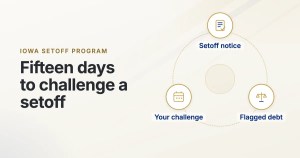
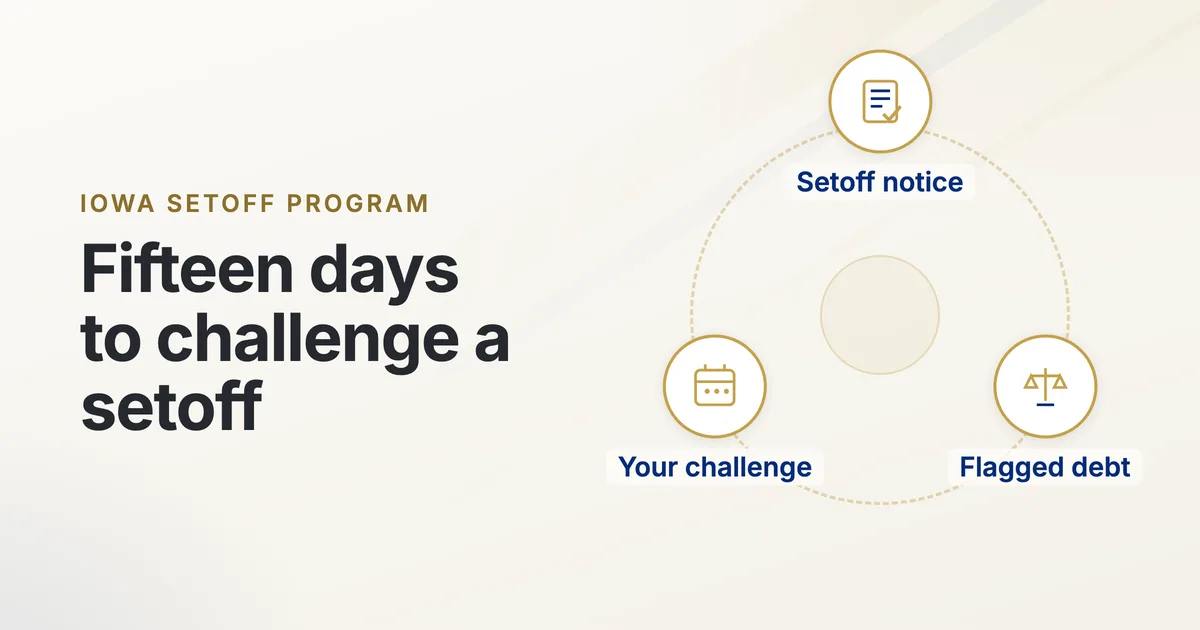
You have 15 days from the date on the Notice of Setoff to challenge it in writing. The Department then responds within 10 business days of receiving your challenge.
It accepts three kinds of challenge. The debt isn’t qualified, the person matched isn’t you, or the amount is wrong. “I can’t afford it” isn’t one of them, so a hardship argument belongs with the agency you owe, not in the challenge.
If you filed jointly and the refund was taken for your spouse’s debt, you can ask for your share within the same 15 days. That’s a separate request from the challenge, made through the same Respond to a Letter option.
Iowa’s setoff and the federal Treasury Offset Program
The Iowa program can’t touch your federal refund. The Department says that directly, and it sends federal questions to the IRS at 1-800-829-1040.
A federal refund is taken through the federal Treasury Offset Program instead. How do you know if you’re in the Treasury Offset Program? Call its automated line at 1-800-304-3107, which the Bureau of the Fiscal Service lists for the public, and it will tell you whether a debt is on file and which agency sent it. I cover that program in more detail in my post on the federal Treasury Offset Program.
How the setoff stops for a tax balance
A debt stays in the program until the agency that sent it removes it. For an Iowa tax balance, the Department says that happens when the debt is paid in full, when a bankruptcy stay applies, or for other reasons that justify stopping collection.
A payment plan doesn’t stop it. The Department’s page says a payment agreement doesn’t prevent it from applying payments to your balance, which is exactly why a refund can still be taken while you’re making monthly payments. I explain that in more detail under why a payment plan does not stop a setoff.
So the question becomes how to clear the balance itself. That can mean paying it, settling it, or fixing an assessment that was wrong to begin with. If you owe the IRS as well, the federal installment agreement is a separate track that has to be planned alongside the Iowa one.
That’s the work I do from my West Des Moines office and from Omaha, resolving the debt behind the setoff with a flat fee quoted before you commit. When you call, you get me.
FAQ
How do I know if I’m in the Treasury Offset Program?
Call the Treasury Offset Program’s automated line at 1-800-304-3107. It tells you whether a federal debt is on file and which agency referred it. The Iowa setoff program is separate and can’t take a federal refund.
What is a tax setoff?
It’s the government keeping money it owes you, such as a tax refund, to pay a debt you owe. In Iowa, the Department of Revenue holds back the payment, applies it to the debt and sends you a Notice of Setoff.