
Nebraska will put you on a payment plan. It will not do it on your terms, it will not do it before a particular piece of paper exists, and it will not do it for as long as most people assume.
Does Nebraska Set Up Payment Plans
Yes. The Nebraska Department of Revenue offers a payment plan for individuals and a separate one for businesses. You request it online after a balance due notice arrives, it runs on automatic payments from a bank account, and the Department expects the balance cleared within 24 months. Interest on the unpaid tax accrues throughout.
That last sentence is the Department’s own, near enough. Its payment plan page ends with the line “Interest on unpaid tax will continue to accrue”, which is a more honest description of a payment plan than most private firms give.
How to Request One
Through the Department’s online system
This is where the first surprise lands. The Nebraska payment plan is not run inside revenue.nebraska.gov. It is operated by Tyler Technologies, and clicking through from the Department’s page redirects you to Tyler’s site to submit the request. Registration on that system is required and acts as your identity verification.
That is not a problem, but it does mean people who assumed they had reached the Department sometimes back out of a page that looks like a third party and never finish.
What they ask for
The Department publishes the list. You will need your DOR-issued Nebraska ID number, which appears on the balance due notice; your Social Security number, and the Social Security number of a joint responsible party if there is one; a contact phone number; a valid email account; and a savings or checking account.
Note what is on that list and what is not. There is a bank account on it, because the plan runs on electronic payments. There is no financial statement on it, no expense worksheet, and no proof of hardship. For a standard plan inside the standard term, Nebraska is not asking you to justify anything. That is a meaningfully lighter process than the federal equivalent, and it is worth understanding before you assume this will be an ordeal.
The one thing that has to exist first
You cannot open a plan on a balance the Department has not billed. The sequence runs like this. File the return, the balance goes unpaid, a balance due notice arrives in the mail, and that notice carries the Nebraska ID number that lets you register. If you know you owe and you have not filed, there is nothing to arrange yet, and filing is the whole task in front of you.
What the Terms Look Like
How many months Nebraska will actually give you
Nebraska’s stated options run in tiers. Pay in full. Pay the entire amount within 90 days as three equal installments, 30 days apart. Or pay over more than 90 days up to a maximum of 24 months. Beyond 24 months, you are into a hardship request, which is a different conversation with a different burden of proof.
Twenty-four months is the number to hold on to. If your balance divided by 24 is a payment you cannot make, the standard plan is not going to work and you should know that before you apply rather than after you default.
The fees, which are small but not nothing
The Department’s published payment plan FAQ records a $1.75 convenience fee added by its vendor to each electronic check payment, and a $20 fee for an electronic check returned without payment, which it describes as non-abatable, meaning it will not be waived. On a 24 month plan the convenience fees add up to $42, which is not the issue. The returned-payment fee is the issue, because it arrives at exactly the moment you could least afford it, and it is the one the Department will not remove.
The penalties, which are larger than the fees
If the reason you are looking at a payment plan is that a return went in late or short, the Department publishes what that costs. A late filed return draws 5 percent per month of the unpaid tax at the due date, to a 25 percent maximum. Late payment draws 5 percent of the unpaid tax. Partial payment draws 5 percent as well.
A payment plan does not remove any of that. It arranges what you owe after the penalties are already on the balance.
Interest, which is not small
Interest accrues on the unpaid tax throughout. Nebraska does not set that rate at the Department’s discretion. Under Neb. Rev. Stat. §45-104.02, the rate on delinquent state taxes is redetermined every other year by the Tax Commissioner, and is set at the average short-term federal borrowing rate for July of the previous year, rounded to the nearest whole percentage point, plus three percentage points. The statute also provides that if the recalculated rate would not move the existing rate by at least two percentage points, the old rate stays.
That mechanism is why the state rate does not track market moves closely and can sit unchanged for years. Check the current figure with the Department before you rely on a number you read somewhere.
What the Department Will Not Agree To
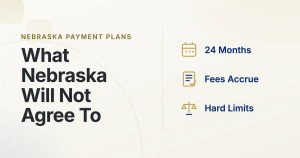
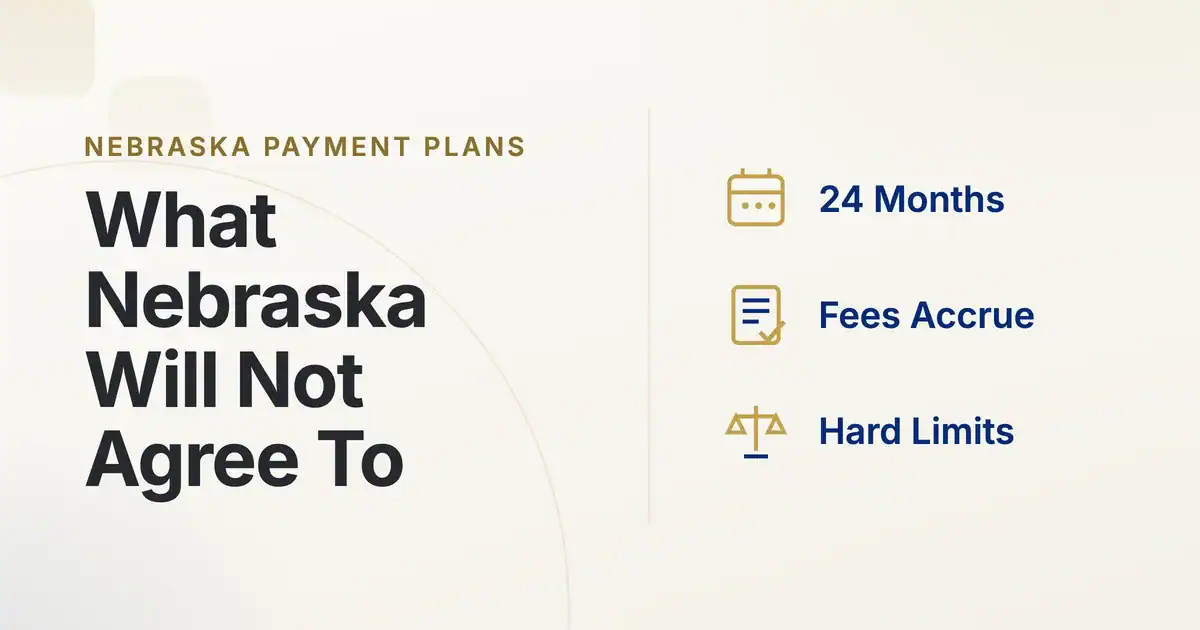
It will not stretch a standard plan past 24 months.
It will not open a plan before a balance due notice exists.
It will not let you change the arrangement yourself. Changing a bank account, making an additional payment, canceling a payment, or dealing with a refund being applied to the balance all require contacting the Department directly. There is no self-service edit.
And it will not waive the returned-payment fee described above, which it labels non-abatable for a reason.
What Happens If You Default
A defaulted plan puts you back into collections, and Nebraska’s collection tools are separate from the IRS’s. The Department maintains its own levy and garnishment process, with a separate assistance track for taxpayers already facing one, and its own settlement request process. Interest never stopped running.
The practical point is that a default is worse than never having applied, because it tends to arrive alongside a collection action rather than a phone call.
Nebraska Is Not the IRS and the Two Do Not Talk
If you owe both, you have two problems, and solving one does nothing for the other. The IRS runs its own installment agreement program with different terms, different thresholds and a different application. A Nebraska plan will not stop federal collection, and a federal agreement will not stop the state.
I mention this because the most common mistake I see on state balances is a taxpayer who has carefully resolved the federal side, assumed the state was included, and finds out otherwise from a Department notice a year later.
If You Are Already Behind in Nebraska
File everything first. Then read the balance due notice for the Nebraska ID number and check the actual figure, because the number people carry in their heads is usually the tax and not the tax plus what has accrued since. Then divide by 24 and be honest with yourself about whether that payment is one you can make every month for two years.
If it is, the online request is straightforward and you do not need me for it. Genuinely. Read about tax help for Omaha residents and businesses for a sense of where my approach differs, but a clean 24 month plan on a filed year is a job you can do yourself.
If it is not, or if there are unfiled years, or if the IRS is in the picture too, that is when it is worth a conversation. Here is what I actually do.
I am based in Omaha, I take the calls myself, and I will say when you can handle something without paying anyone. That is how I work, and here is how to get in touch.
FAQ
Is the Nebraska extension automatic?
Nebraska does have an extension of time to file, and the Department directs taxpayers to page 3 of the Individual Income Tax Booklet for how to request one, so check there or ask the Department rather than assuming your federal extension carries over untouched. What matters more for anyone reading a payment plan article is what an extension does not do. It does not extend the time to pay. The Department’s own penalty schedule applies late payment and partial payment penalties to unpaid tax measured “at the due date or extended filing date”, which means the balance is still expected on time even when the paperwork is not.
What is the last day to file taxes in Nebraska?
The Nebraska individual income tax return is due on the same date as the federal return, which is April 15 in an ordinary year and moves to the next business day when the fifteenth falls on a weekend or holiday. Extended returns are due in October. If you are reading this because you owe, the filing date matters less than the fact that the balance was due in April.
Do you have to pay state taxes in Nebraska?
Yes. Nebraska levies an individual income tax, and residents and most people with Nebraska-source income are required to file and pay. That is why a Nebraska balance can exist entirely separately from anything you owe the IRS, and why resolving one does not touch the other.